Ofsted Reports Are Moving House Prices and Your Traffic: A Catchment SEO Playbook for UK Agents
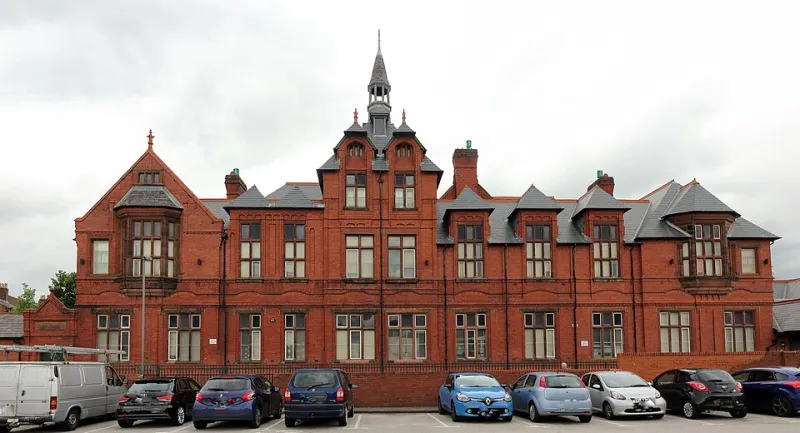
Photo: Rodhullandemu, CC BY-SA 4.0, via Wikimedia Commons
Ask any negotiating team in a family-focused agency which question dominates weekend viewings, and the answer is rarely about the kitchen. It is: 'Which school does this feed into?'
Yet walk through the average independent agency's website and you will struggle to find a single page built around that question. There are pages for the town, pages for the villages, perhaps a page for a popular development — but almost nothing that speaks to the single most powerful filter in family property decisions: the catchment line.
What the Search Data Actually Shows
When we analyse query patterns across agency search consoles, a consistent shape emerges. Generic terms such as 'estate agent [town]' are heavily contested and heavily commoditised. But long-tail variants — 'houses for sale near [school name]', 'is [road] in [school] catchment', '3 bed homes [school] ofsted rating' — behave entirely differently.
Three characteristics stand out:
- Intent is further down the funnel. A parent typing a school name into Google has usually already chosen their area. They are not browsing; they are shortlisting.
- Competition is thin. Portals optimise for broad location terms. Catchment-specific queries are largely unclaimed, which is why a modest, well-structured page can outrank national players.
- The audience is loyal. Catchment searchers return repeatedly during an application cycle, often across two or three school years before they transact. That is repeat traffic most agencies never think to court.
The Ofsted effect compounds this. When a report is published — particularly an upgrade — search interest in the surrounding streets spikes within days. Agencies with no catchment content are invisible during exactly the window when motivated family buyers are most active.
Why Generic Location Pages Fail This Audience
A standard area page says: 'Our charming market town offers excellent schools.' A catchment page says something verifiable, specific and useful: which streets fall inside the admission priority area for [School Name], what the last Ofsted judgment was, what the PAN (published admission number) implies about competition for places, and which of your current instructions sit within it.
That gap between vagueness and specificity is precisely where rankings are won. Search engines reward pages that answer the question completely; parents reward them with bookmarks, shares in WhatsApp groups and, eventually, valuation enquiries.
A Five-Part Framework for Catchment Landing Pages
We recommend a repeatable template, one page per school, built as follows:
1. The catchment map. Embed the school's admission priority area, sourced from the local authority's published determiners. Where catchments change annually, show the current and prior year side by side — this alone earns links from confused parents.
2. The performance snapshot. Summarise the latest Ofsted grade, Progress 8 or equivalent measures, and Ofsted Parent View sentiment. Keep it factual and dated. Never editorialise a school's quality; report it.
3. The stock list. Dynamically display live instructions within the catchment boundary, with a fallback evergreen section ('Recently sold in the [School] catchment') so the page never looks empty.
4. The admissions context. Note PAN, oversubscription criteria and typical last-admitted distance. This is the content parents cannot easily find anywhere and will share widely.
5. The valuation bridge. Close with a single, specific call to action: 'Selling within the [School] catchment? Family buyers are actively searching here — request a valuation.' Frame it around the buyer demand the page itself demonstrates.
Timing, Maintenance and the Vendor Dividend
Publish pages in the autumn, ahead of the secondary and primary application deadlines in October and January, when catchment queries peak. Then maintain them: Ofsted re-inspections, catchment consultations and admission arrangements all change, and a stale page is worse than none.
The commercial payoff arrives in two waves. First, buyers arrive — high-intent, pre-qualified by the school they have chosen. Second, and more valuably, vendors arrive. A homeowner whose street sits in a sought-after catchment searches the same terms, sees your agency demonstrating genuine local knowledge, and draws the obvious conclusion about who will market their property best.
Catchment SEO is not a gimmick. It is simply the discipline of building pages around the real criteria families use to choose a home — and, by extension, the criteria they use to choose an agent.